

Production Area/Shiga Prefecture

Breezy and refined, Omi Jofu is a high-grade ramie textile traditionally woven in the eastern region of Lake Biwa. The area’s warm and humid climate is ideal for crafting this delicate fabric, which is vulnerable to dryness. With a history dating back over 600 years, Omi Jofu is known for its entirely hand-crafted production process. It features two main techniques: kibira (plain woven ramie) and kasuri (ikat). In 1977, it was officially designated as a Traditional Craft of Japan.
In This Article:
- The origins of Omi Jofu and its history since the Edo period
- Traditional techniques using ramie fiber and the secret behind its cooling effect.
- Advanced artisan skills such as kasuri-kukuri (ikat binding) and hand weaving.
- The light, breathable texture ideal for summer kimono.
- Its Cultural Value as an Important Intangible Cultural Property.
Table of Contents
Enjoying Summer in Style with Fine Omi Ramie,
Once Offered as Tribute to the Shogunate

The history of Omi Jofu dates back centuries. It is believed that weaving techniques were first brought from Kyoto during the Kamakura period (1185–1333). By the Muromachi period (1336–1573), bolts of fabric were gathered in Takamiya—now part of Hikone City—and distributed throughout Japan, giving rise to the name “Takamiya-nuno.” During the Edo period, Omi Jofu flourished further under the patronage of the Hikone domain and was even presented as tribute to the Tokugawa shogunate, securing its status as a prestigious ramie textile. In recent years, however, production has declined, making it a rare and treasured fabric today.
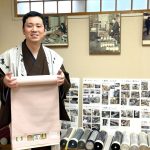
To explore the enduring appeal and preservation efforts surrounding Omi Jofu, we visited the Omi Jofu Traditional Industry Center, operated by the Shiga Ramie Textile Industrial Cooperative Association, and spoke with Ms. Yumiko Tanaka, the center’s director.
A Tradition Since the Muromachi Period
Preserving the Mastery of Artisans
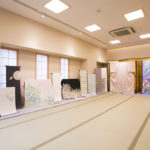
The Omi Jofu Traditional Industry Center, located in a tranquil town in eastern Shiga Prefecture, is dedicated to sharing information about Omi Jofu, Omi Asa (hemp), and Omi Chijimi, while also fostering the next generation of successors.

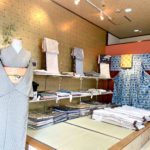
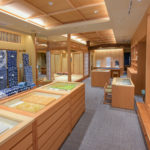
Stepping through the doors of this retro Taisho-era building, which once served as a county office, you are greeted by an array of hemp fabrics and handcrafted items made from them. On a display torso, an elegant Omi Jofu adorned with charming kasuri patterns is carefully draped, exuding an air of refined grace and cool elegance.
“The defining characteristic of Omi Jofu, passed down for about 600 years, is that every step of the process is done entirely by hand,” says Ms. Tanaka. “There are two main techniques: Kibira (plain weave) and Kasuri (ikat patterns). In 1977, Omi Jofu was designated as a Traditional Craft of Japan by the government.”
“Kibira,” woven from undyed hemp yarn, is a fabric that has inherited techniques from the Muromachi period. It uses ramie for the warp and hemp for the weft, handwoven on a traditional ground loom. This weaving tradition continues the legacy of making hemp cloth once known as “Takamiya-nuno“.

Hemp yarn is produced using a technique called "teumi " (hand-joining), in which fibers extracted from the stalk of the hemp plant are finely split and then twisted together with the fingertips, without creating any knots.
Ms. Fumiyo Tateishi, a craftswoman with 20 years of experience in the art, demonstrated "teumi " for us. With astonishing speed, she joins the fibers one after another, creating long, delicate hemp threads. Yet, even for a seasoned artisan like her, only a few grams can be produced in a single day.
Next, Ms. Tateishi sat at a "jibata " (traditional ground loom) to demonstrate weaving with the threads she had just spun. For "Kibira " cloth, it is a requirement that the weaving be done on this now-rare loom, also known as a "koshibata " (waist loom), in which the warp threads are fastened around the weaver’s waist and woven by hand.

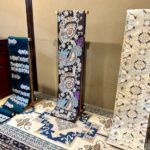
Because the weaver’s own body becomes part of the loom, progressing the weave is more challenging than on a high loom, requiring precise control of the beating force and other advanced skills. The result is a delicate, soft, and exquisite texture. "Kibira " is left undyed to highlight the natural color and texture of hemp, and is primarily woven for summer obi.
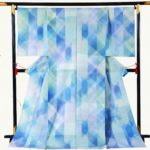
The cool, breezy kasuri patterns of Ōmi-jōfu
are coveted pieces that elevate any summer ensemble.

On the other hand, "kasuri" is a woven fabric in which the threads are dyed to create patterns before weaving. There are two dyeing methods: "kushi-osa-nassen" and "katagami-nassen". "Kushi-osa-nassen " produces warp-"kasuri" by pressing a comb-like tool onto the warp threads to dye them, while "katagami-nassen" produces weft-"kasuri" by winding the weft threads around a metal frame and dyeing them through a stencil. Both types are woven not on the "jibata" ground loom, but on a "takabata", a more common handloom.

In the past, white and navy were the standard colors, but today pastel shades have also grown in popularity.
Thanks to the refined quality of this hemp fabric, even these lighter hues convey an air of elegance and composure.
Both "kibira" and "kasuri" require an extraordinary amount of time and skill to produce, and with such limited output, Ōmi-jōfu has come to be known as the "phantom " of fine hemp fabrics.
While it is rare to encounter in the market, the Ōmi-jōfu Traditional Craft Museum offers bolts of this precious textile for sale—an indulgence only possible when visiting the place of its origin, where each year its rarity and value continue to grow.

Preserving and Passing Down
the Rare Hemp Textiles Born from Traditional Industry
The Ōmi-jōfu Traditional Industry Museum is also dedicated to passing on its techniques, launching the *Successor Training Project* in 2014.
“They are still far from reaching the level of veterans like Ms. Tateishi, but it is truly encouraging to see both "nama-hira" and "kasuri" artisans growing together,” says Ms. Tanaka.

Surrounded by mountains and nourished by the abundant waters of Lake Biwa, the “mother lake” of Shiga, Ōmi-jōfu has been cherished here for centuries.
Thanks to the quiet yet steadfast efforts of the local people—determined to ensure that this treasured craft will never fade away in their time—the tradition of Ōmi-jōfu continues to be preserved and passed down to future generations.
At the Ōmi-jōfu Traditional Industry Center, visitors can take part in hands-on experiences such as weaving on a "jibata " (traditional ground loom) or hand-spinning hemp fibers from "ōasa".
By touching the materials and trying the processes for yourself, you can truly appreciate the charm of Ōmi-jōfu and the value of the craftsmanship behind it.
Woven from ramie and linen,
hemp textiles gracefully woven into modern life

Though the traditional Ōmi-jōfu has become a rarity today, its legacy continues to breathe deeply within the region’s textile industry. Woven slowly on machines from materials such as ramie and linen, “Ōmi no Asa” and “Ōmi Chijimi” have become proud local brands of fine hemp textiles.

Among them, the uniquely crimped “Ōmi Chijimi,” prized for its cool touch, is sometimes hand-pleated in addition to being machine-woven. By today’s standards, it remains a fabric of remarkable craftsmanship and care. The original brand of the Ōmi-Jōfu Traditional Industry Center, "Omi-jofu", also uses "Ōmi no Asa" in items such as hand towels and handkerchiefs.
“Omi-jofu includes both handwoven and machine-woven pieces, but in both, we strive to preserve and highlight the beauty of tradition to the fullest,” says Ms. Tanaka.
While preserving tradition, "Omi no Asa" also embraces new techniques and modern designs. With a wide variety of colors and patterns, these fabrics are offered at accessible prices, attracting customers not only for making clothing and bags, but also for tailoring summer kimono and yukata.

The historic crafts of "Kibira " and "Kasuri", alongside the evolving "Omi no Asa" and "Omi Chijimi" that adapt to the times, coexist within the Omi-jofu Traditional Craft Center.
Here, the legacy of 600 years of hemp weaving carries with it the responsibility of preserving the region’s heritage for the future.

____________________________________
Omi-jofu Traditional Craft Center
Echigawa32-2 Aisho town Echi district Shiga prefecture
(Inside Yumemachi Terrace Echi)
TEL +81-749-42-3246
Official Website>>
__________________________________
Text & Interview by Miki Shirasu
→ See also: The Texile Encyclopedia | Omi-jofu(Shiga Prefecture)