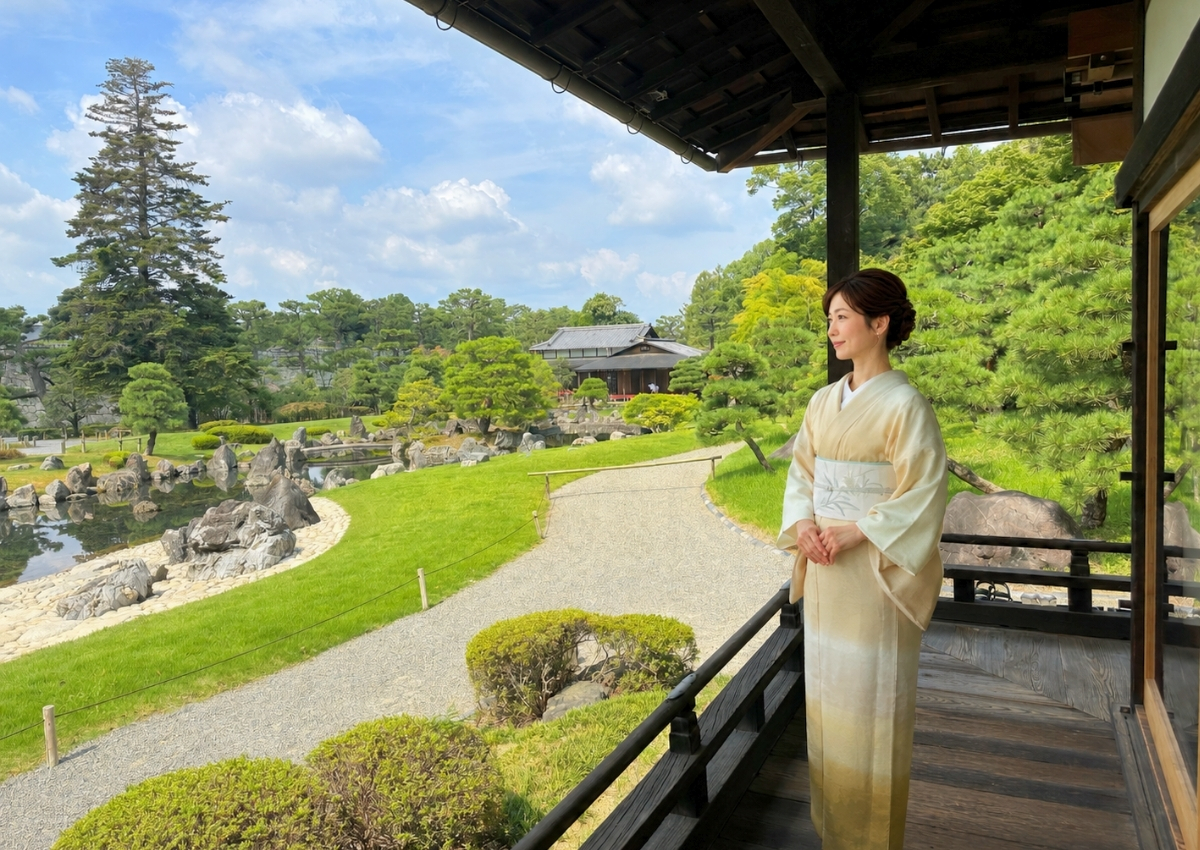
A travel journal exploring places where kimono feels especially at home. This time, I visited Nijo Castle, one of Kyoto’s most celebrated World Heritage sites. The castle is impressive enough for its grand Karamon Gate and the National Treasure Ninomaru Palace, but I discovered a slightly different way to experience it: a limited-time breakfast at Koun-tei, a building that is normally closed to the public. With views over Seiryu-en Garden, the breakfast is available by advance reservation only and limited to 40 guests per day. Sitting down to a quiet morning meal in kimono, surrounded by a castle steeped in Tokugawa history, felt almost like borrowing a little of Ieyasu Tokugawa’s world for the morning. It was a deeper, more immersive way to experience Nijo Castle—one that went beyond conventional sightseeing.
Table of Contents
Nijo Castle: A Witness to Tokugawa History
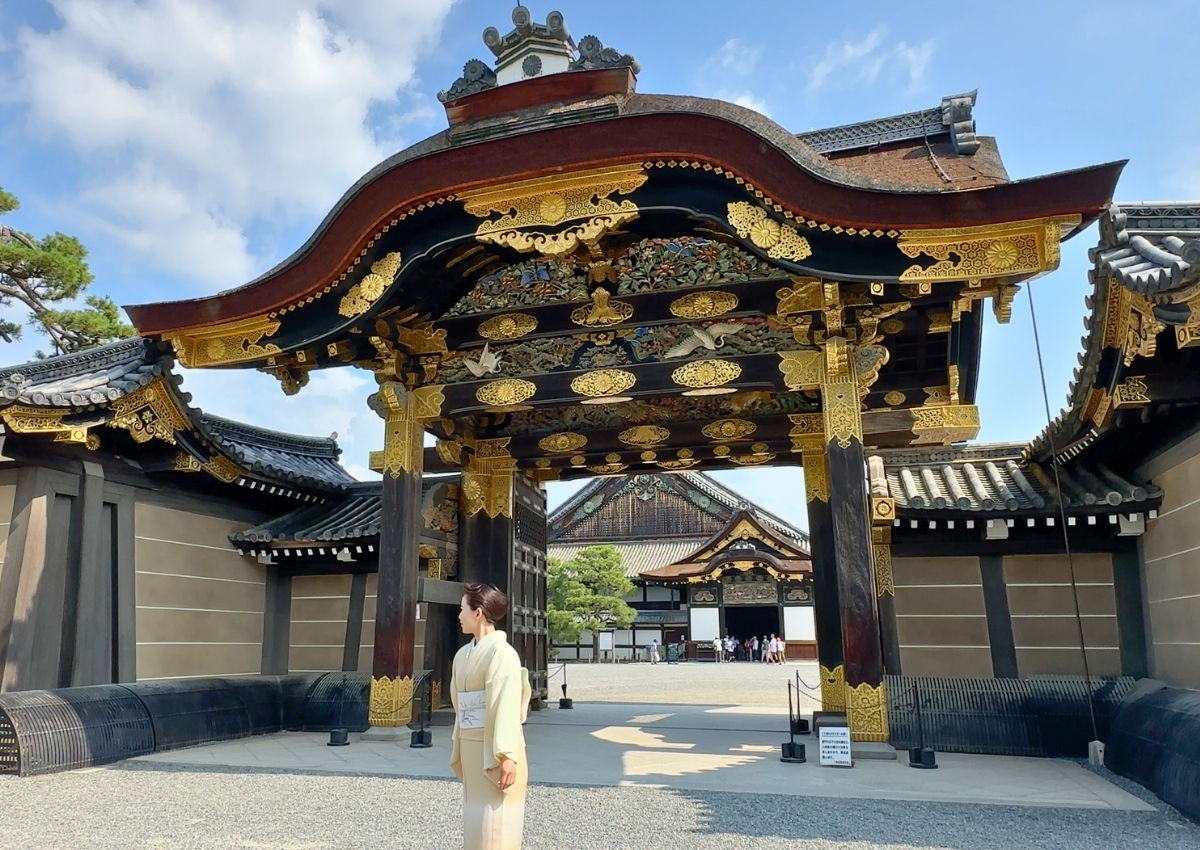
The history of Nijo Castle begins in the age of Tokugawa Ieyasu. In 1601, Ieyasu ordered the feudal lords of western Japan to take part in its construction, and by 1603 the area corresponding to today’s Ninomaru had been completed. Ieyasu himself entered Nijo Castle for the first time that same year. Later, during the rule of the third shogun, Tokugawa Iemitsu, the castle underwent major renovations, and by 1626 it had largely taken on the scale and form we recognize today. In 1867, near the end of the Edo period, the fifteenth shogun, Tokugawa Yoshinobu, announced his intention to return political power to the Imperial Court from the Ninomaru Palace. In this way, Nijo Castle witnessed major turning points in Japanese history, from the rise of the Tokugawa shogunate to its eventual end. Passing through the imposing gates and walking through the expansive grounds in kimono, there are moments when modern-day Kyoto seems to fade away, and you feel as though you have slipped quietly into the Edo period.
Entering Koun-tei, Normally Closed to the Public
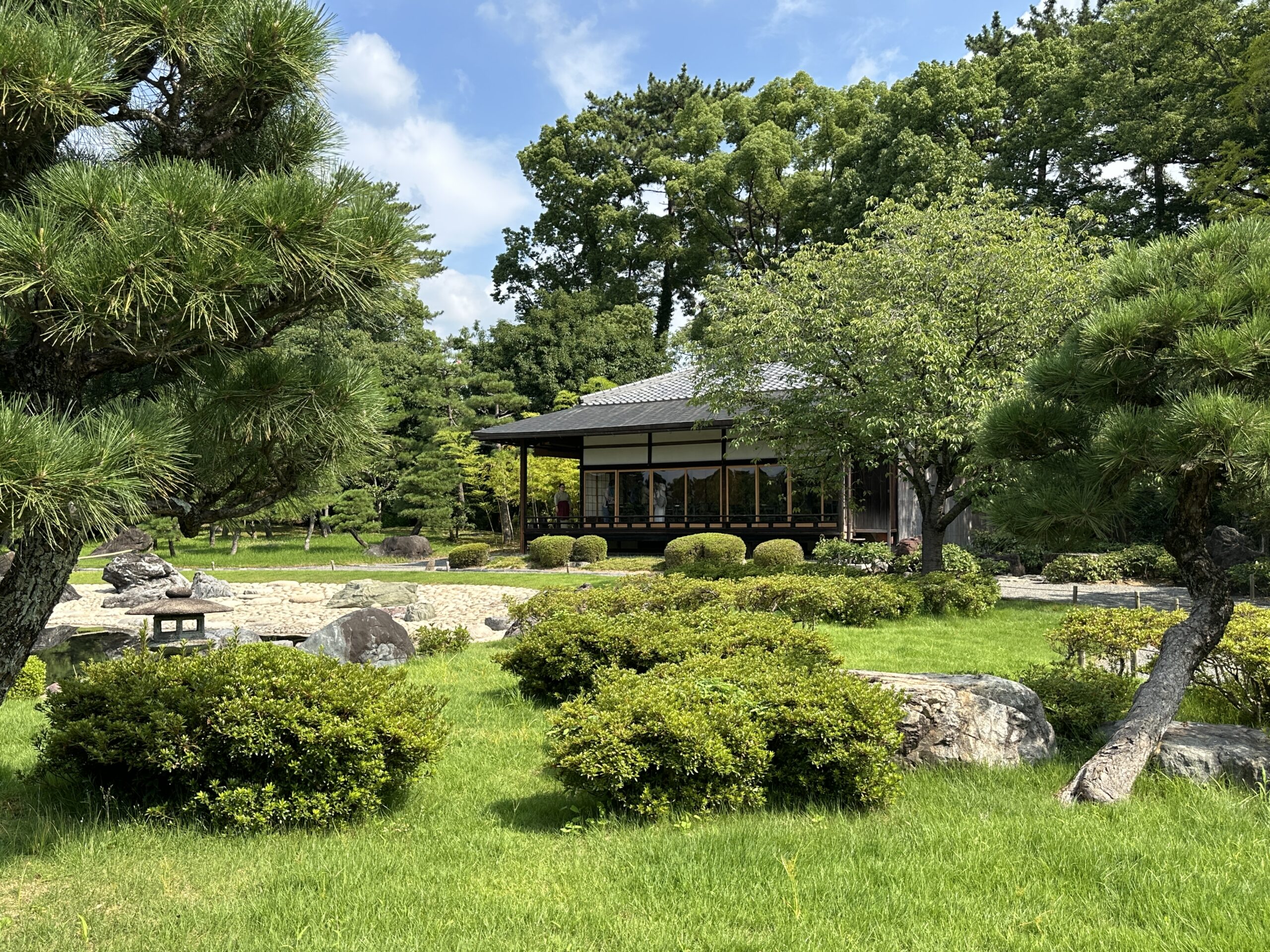
This time, my destination was Seiryu-en, a garden located in the northern part of Nijo Castle. Created in 1965, it combines a traditional Japanese garden on the western side with a Western-style lawn garden to the east.
Nestled within this landscape is Koun-tei. The building was relocated from the former residence of the Suminokura family, a prominent merchant family in Kyoto.
Koun-tei is normally closed to the public, and on a regular visit it can only be viewed from the outside, from the south. During limited periods in summer and winter, however, meals are served here, offering a rare opportunity to step inside the building.
After removing your zori, you step into a tatami room. Beyond the wide-open interior, the carefully maintained greenery of Seiryu-en Garden fills the view.
Tourists continue to move through the castle grounds in the distance, while only those with reservations are able to spend the morning quietly here.
It offers a perspective on Nijo Castle that feels quite different from simply walking through and sightseeing.
Enjoying the “Kyoto Yuba Rice Porridge Breakfast” with Views of Seiryu-en Garden
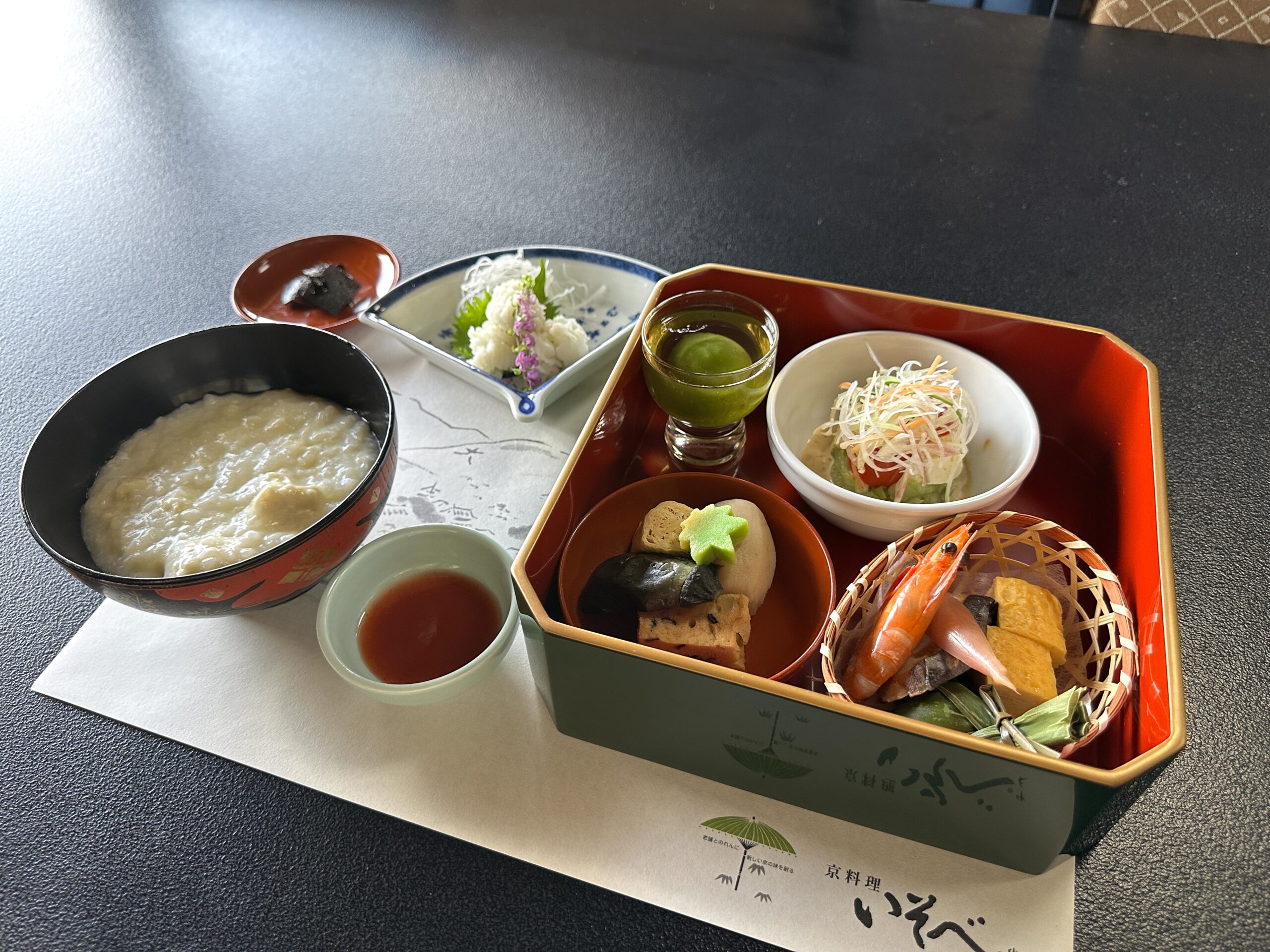
I enjoyed the “Kyoto Yuba Rice Porridge Breakfast” prepared by Kyo-ryori Isobe, a Kyoto restaurant specializing in traditional cuisine. At the heart of the meal is yuba-gayu, rice porridge made with freshly prepared kumiage yuba, or soft, freshly lifted tofu skin. The accompanying basket includes delicacies such as Japanese rolled omelet, fish grilled in a yūan-style marinade, and simmered shrimp, alongside dishes such as yuba shinjo and a yuba salad. Another highlight is the monthly seasonal specialty. In July, it is hamo otoshi (lightly poached pike conger); in August, Kamo eggplant shigi-yaki; and in September, ayu tatsuta-age. I visited in July, when hamo is one of Kyoto’s signature summer ingredients. Dipping the beautifully opened white pieces of hamo into plum sauce while looking out over the garden made the morning feel especially elegant.
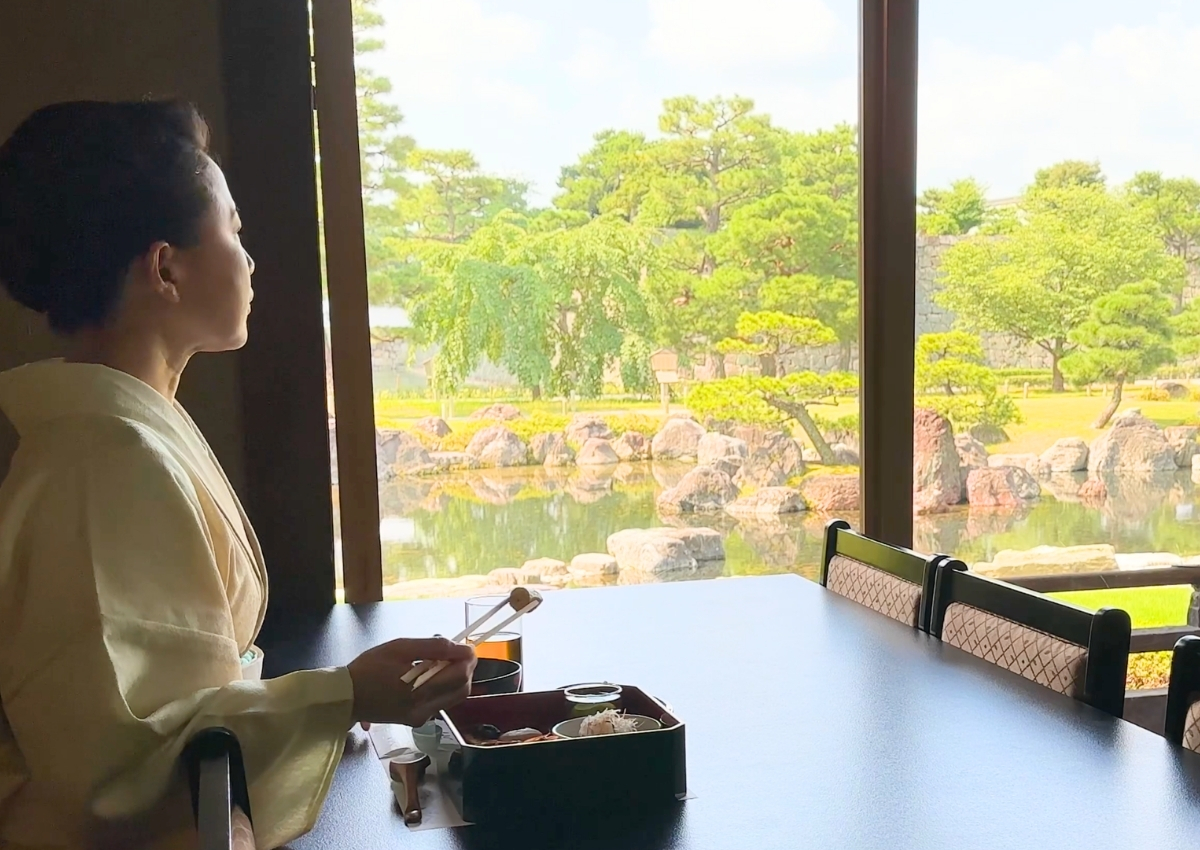
And this special breakfast experience is priced at ¥4,500. Considering that it includes access to a space normally closed to the public, together with Kyoto cuisine enjoyed overlooking Seiryu-en Garden, it is an experience well worth adding to a Kyoto itinerary. In 2026, the breakfast is offered for a limited period from July 15 to September 27, with just 40 guests accepted each day.
Breakfast Like a Shogun at World Heritage Nijo Castle
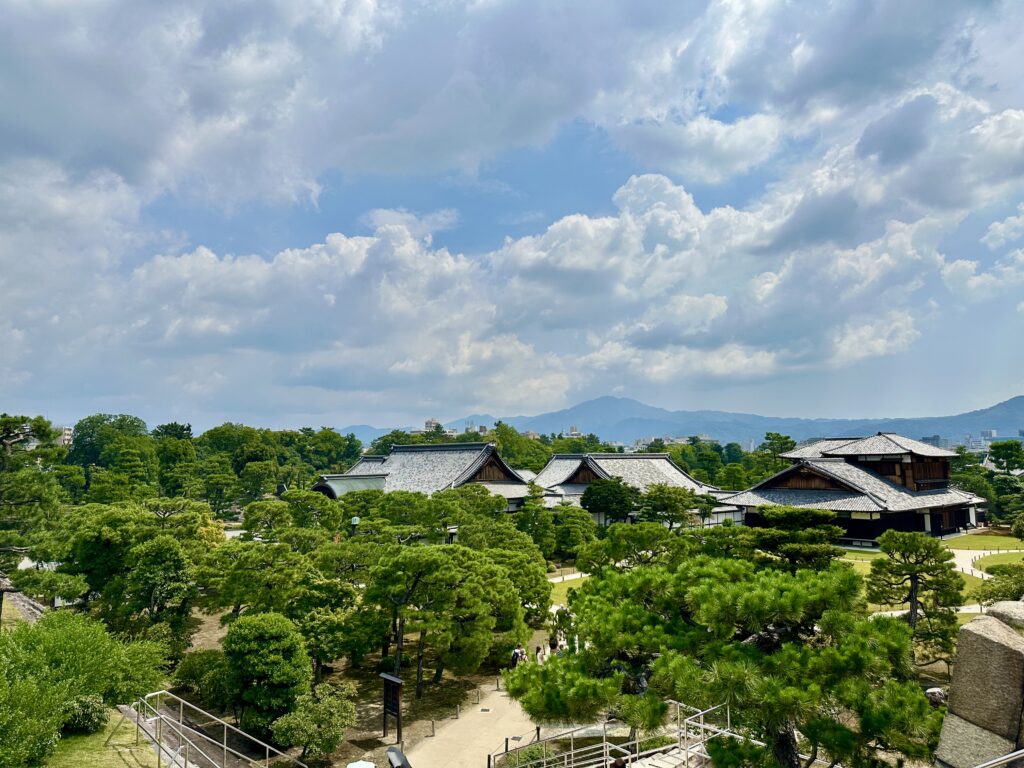
After breakfast, I returned to explore the castle grounds. To the southwest of the Honmaru Palace, a five-story castle keep once stood. It was destroyed by lightning in 1750, and today only the stone foundation remains.
Climbing the stone steps to the former keep site offers sweeping views over the Honmaru Palace, the Honmaru Garden, and the city of Kyoto beyond.
Standing atop the former castle keep in kimono and looking out over Nijo Castle, I found myself thinking back to the breakfast I had enjoyed only a short while earlier, seated before the garden.
A shogun-like breakfast in a castle steeped in Tokugawa history—allowing yourself that little touch of imagination is part of the pleasure of travel.
Why Nijo Castle Is Especially Worth Visiting in Kimono
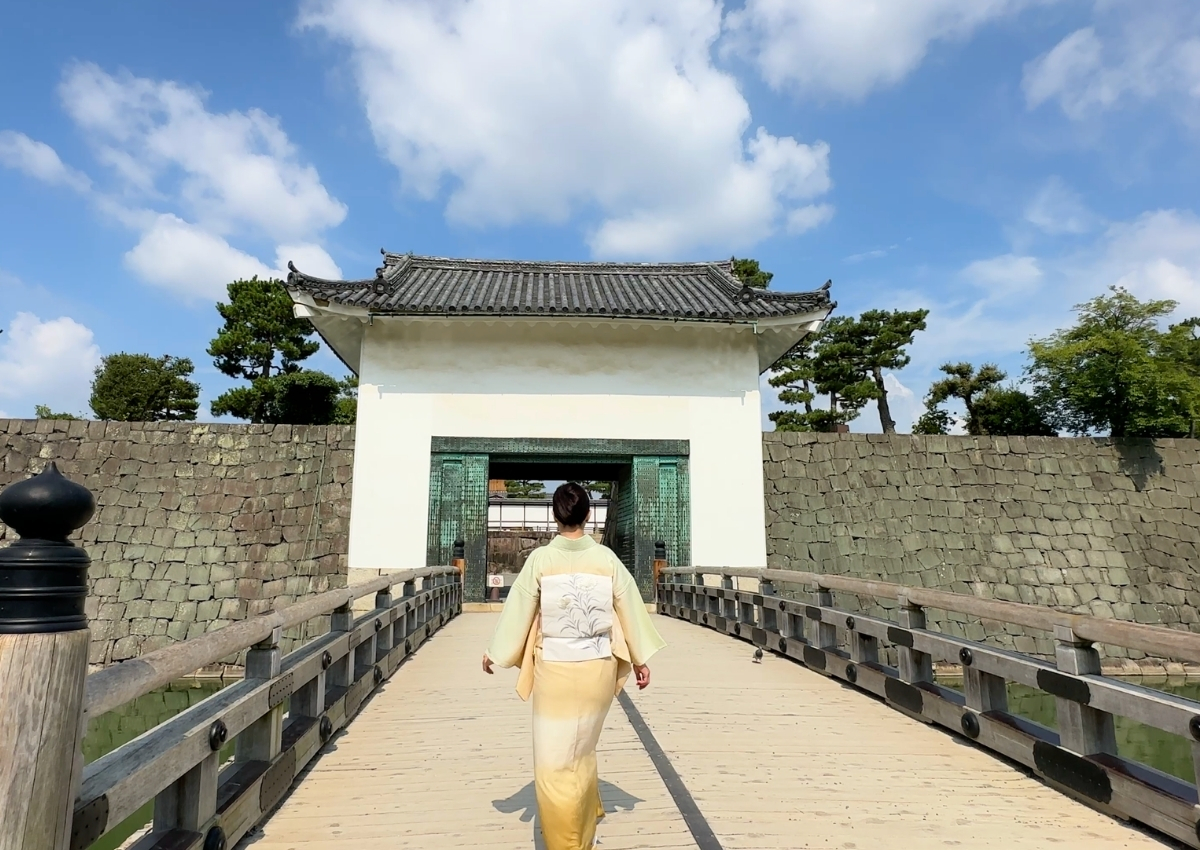
Nijo Castle offers countless scenes where kimono feels naturally at home: the castle architecture, palace interiors, and Japanese gardens.
Yet what I was reminded of on this visit was that wearing kimono here becomes more than simply part of a memorable sightseeing experience. Stepping into a tatami room, looking out over the garden, and holding the carefully prepared dishes in hand, the act of wearing kimono itself became part of the experience of being in a historic place.
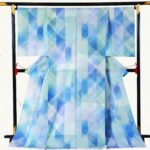
For this visit, I chose a summer monsha hōmongi by Jukō-ori, suited to the heat of Kyoto.
The sheer, airy texture of the summer kimono felt beautifully in tune with the dignified scenery of Nijo Castle, surrounded by lush green foliage.
Reflecting the season through what you wear, then seeking out landscapes that can only be experienced at that particular time of year, is one of the unique pleasures of traveling in kimono.
Experiencing Nijo Castle Through All Five Senses
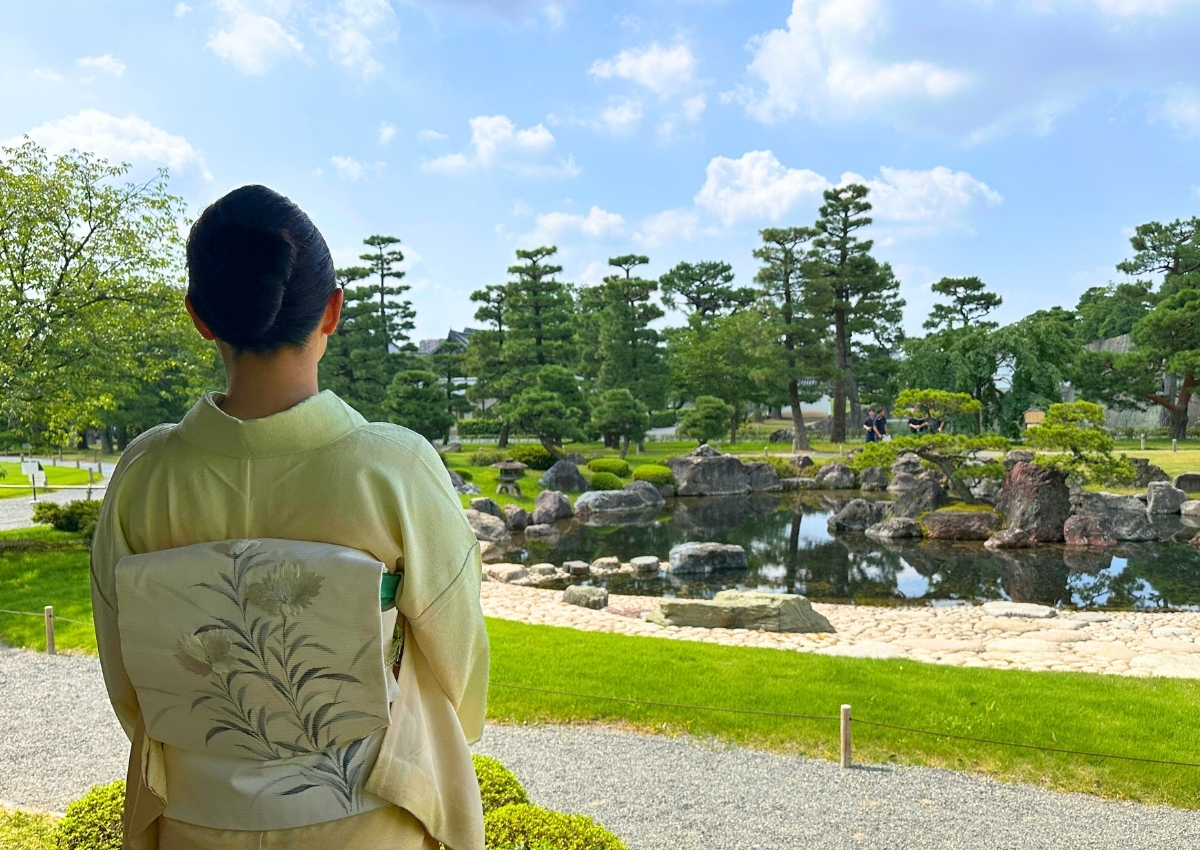
When we think of a World Heritage site, we often imagine walking from one landmark to another and admiring historic buildings along the way. Nijo Castle certainly offers plenty to see, from the Karamon Gate and Ninomaru Palace to the Honmaru Palace and its gardens.
But this visit offered something slightly different. Rather than simply looking at the scenery from the outside, the experience allowed me, if only for a short while, to become part of the time and atmosphere of the castle itself.
Stepping into Koun-tei, normally closed to the public, and settling into the tatami room creates a very different sense of time.
As you enjoy breakfast while looking out over Seiryu-en Garden and watch visitors passing beyond the greenery, the pace feels noticeably slower than when walking through the castle grounds.
Although you are still within the same Nijo Castle, the experience somehow changes the way time itself seems to flow.
After the meal, I returned to the castle grounds. This time, I walked through the very landscape I had been looking out at from the tatami room only moments before.
By layering the experience of seeing, tasting, and walking, Nijo Castle began to feel more three-dimensional—not simply as a sightseeing destination, but as a place with its own unfolding story.
This is a side of Nijo Castle that goes beyond conventional tourism, and one of the deeper pleasures of traveling in Kyoto.
Tips for Enjoying This Special Breakfast at a Relaxed Pace
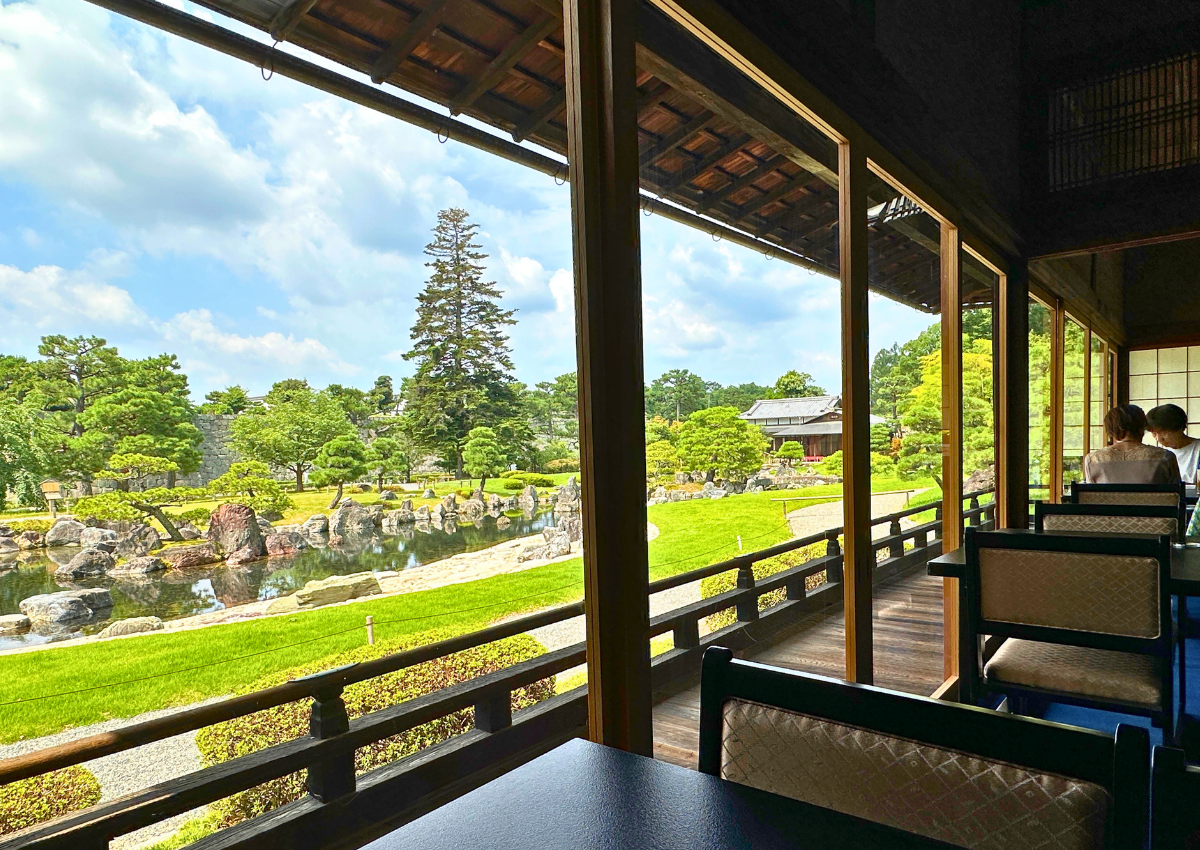
The breakfast at Koun-tei is served from 9:15 to 10:15 a.m., giving guests one hour to enjoy the meal. Because it is a reservation-only experience in a space normally closed to the public, it is worth arriving with plenty of time to spare.
Nijo Castle covers a large area, and Koun-tei is not located immediately inside the entrance, so be sure to allow time to walk through the grounds before breakfast.
If you plan to visit the Ninomaru Palace, Honmaru Palace, or the gardens afterward, it is best to schedule the entire morning with some flexibility. Allowing time not only for breakfast but also for a leisurely walk around the castle will make the experience far more enjoyable.
Also keep in mind that a summer visit to Nijo Castle involves a fair amount of walking outdoors. Bring a parasol, folding fan, and water, and be sure to prepare for the heat.
This is a morning experience available only for a limited season and to a limited number of guests. With a little preparation, you can enjoy this special time at Koun-tei in comfort and at an unhurried pace.
________________________________________
Nijo Castle・Koun-tei “Kyoto Yuba Rice Porridge Breakfast”
Period|July 15 (Wed) – September 27 (Sun), 2026
Time|9:15〜10:15
Location|Koun-tei, Nijo Castle
541 Nijojo-cho, Nijo-dori Horikawa Nishi-iru, Nakagyo-ku, Kyoto
Price|¥4,500 (tax included) Separate admission to Nijo Castle is required.
Capacity|Limited to 40 guests per day / Advance reservation required
Reservations|By 3:00 p.m. on the day before your preferred date
Reservations & Inquiries|Kyo-ryori Isobe
TEL|075-551-1203(Reception hours: 10:00 a.m.–3:00 p.m.)
*Payment is accepted in cash only. Cancellations must be made at least three days in advance.
*Depending on reservation availability, you may be seated with other guests.

In this eighth edition, I visit Kyoto’s Nijo Castle in kimono to experience “NAKED Sakura Festival 2024.” Produced by the creative company NAKED, INC., this evening event blends digital art with cherry blossoms at a World Heritage site, offering photo spots where kimono shines beautifully against a backdrop of light and projection.